Monday, March 17, 2014

Advancements in Electric Hand Dryers Improve Restroom Efficiency

Public restrooms continue to be the culprit of consumer angst, from wet seats and stall floors to germy door handles and a lack of soap. Facility managers have faced the age-old challenge of providing sanitary, hygiene-friendly washrooms for their patrons.

Complaints have mounted. A recent survey by The Trending Machine found that three out of four adults had at least one complaint about public restrooms. More than one-third cited a lack of proper supplies, including paper hand towels, and 43% of respondents were concerned about germy fixtures.

The American Institute of Architects (AIA) cites public health among the most important design criteria for public restrooms. The challenge for building a more desirable public restroom has led electric hand dryer manufacturers to improve on technologies and efficiency, creating faster, more hygiene-friendly products that are replacing the traditional paper hand towels. In the past five years, manufacturers have come up with innovations including touch-free faucets and high-efficiency electric hand dryers using sensors to turn on and off, drying hands in 10 seconds or less.

“Designers and facility managers are placing a higher priority on creating hygiene-friendly public spaces, and this includes restrooms,” says Mike Conlan, founder and CEO of www.handdryersupply.com. “Water and used paper hand towels can be a breeding ground for germs in restrooms. These days, an increasing number of electric hand dryer brands are being designed with bacteria-preventing technologies, meeting LEED and other green building certifications, and could cut costs over time.”

High-efficiency particulate absorption (HEPA) filters, commonly found today in most hand dryer brands, trap mold and germs inside the dryer, reducing 99.9% of bacteria from the air. These benefits, along with cost savings, are leading business owners and facility managers to replace their paper towel dispensers with high-efficiency electric dryers.

A medium-sized business sees around 150 to 200 restroom uses per day. A 12-pack case of 250 towels costs on average about $30, so a restroom that gets a medium amount of usage can expect to use at least one package of paper towels daily, for a total cost of about $75 per month. People typically use at least two towels to dry their hands, and often there is additional waste from extra unused towels pulled out and left on the floor or counter.  Towels must also be bagged and removed from the restroom on a regular basis, so the extra cost of trash bags and maintenance are cost factors.

High-efficiency hand dryers have a higher initial cost – on average, they cost $500 – but their operating cost is about a tenth that of standard hand dryers. A typical electric hand dryer uses about 0.03 kilowatt-hour (kwh) of electricity per use. At an average U.S. cost of $0.0995 per kwh, the cost for using an electric dryer averages out to about $14.58 per month, a savings of more than $60 per month over using paper towels.

Electric hand dryers also are being designed to meet Leadership in Energy and Environmental Design (LEED) certification and GreenSpec standards, a database of more than 2,000 green products used by architects, construction personnel and other building professionals.

A study by The Climate Conservancy demonstrates hand dryers’ minimal environmental impact by comparing carbon dioxide equivalent (CO2e), a measure used to compare various emissions from greenhouse gases based on their global warming potential.  The study revealed that a conventional hand dryer in a restroom emits between 9 and 40 grams of CO2e in 30 seconds or less, depending on the type of dryer, while every time a person uses two paper towels they are responsible for approximately 56 grams of CO2e emissions.

Advancements in technologies give architects, general contractors and facility management executives the opportunity to transition their facilities’ restrooms to more energy-efficient and hygiene-friendly environments. And finally, nothing to complain about.


CNA Specialties, Inc.

Wednesday, March 12, 2014

Syncoat Markerboards

The unique New Syncoat™ writing surface offers exceptional stain and wear resistance. Because of Syncoats™ high gloss finish it also exhibits exceptional writing and erasing qualities.

Syncoat is a synthetic resin surface applied to light gauge steel in a carefully controlled process that provides a uniform finish.

Syncoat is available in a wide variety of sizes, all at a very moderate price. All sizes are full length without seams.
Standard features include:

• Satin anodized aluminum trim
• Matching full length accessory tray
• Molded safety end caps

Optional features include:
Full length 1" display rail with end caps


Thursday, March 6, 2014

Global Partitions

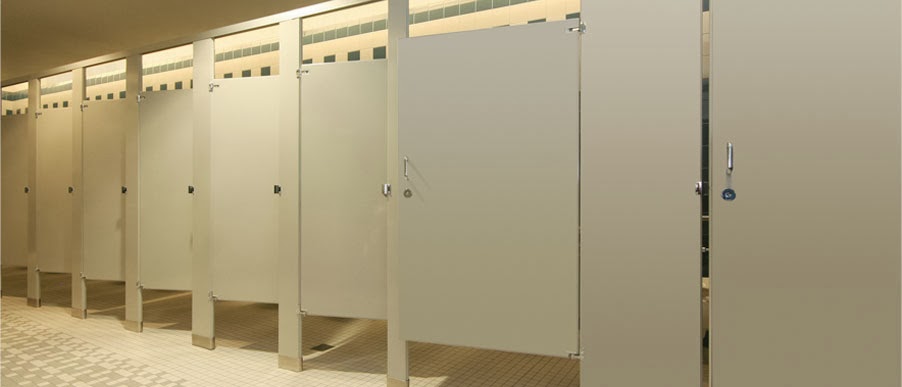
Global Partitions, the most widely specified manufacturer of toilet partitions in the industry, offers a complete line of toilet partitions, from powder coated steel, stainless steel, and solid plastic to black core phenolic, color-thru phenolic and plastic laminate in four mounting styles. With the introduction of their Ultimate Privacy™ design – doors and panels up to 72” high plus their No Sight system – you can turn your toilet stalls into private rooms.

All of Global Partitions’ products qualify for LEED points, helping your building achieve LEED 3 certification.


CNA Specialties, Inc.

Monday, February 24, 2014

Getting physical working at your desk

Glued to your desk at work? Cross that off the list of reasons not to exercise.

A growing number of Americans are standing, walking and even cycling their way through the workday at treadmill desks, standup desks or other moving workstations.

Walking on a treadmill while making phone calls and sorting through emails means "being productive on two fronts," said Andrew Lockerbie, senior vice president of benefits at Brown & Brown, a global insurance consulting firm.

Lockerbie can burn 350 calories a day walking 3 to 4 miles on one of two treadmill desks that his company's Indianapolis office purchased earlier this year. "It's great to be able to have an option at my work to get some physical activity while I'm actually doing office stuff," he said.

Treadmill desks designed for the workplace are normally set to move at 1 to 2 miles per hour, enough to get the heart rate up slightly but not too fast to distract from reading or talking on the phone comfortably. But some experts frown on the trend.

"It's absolutely crazy," Cynthia Roth, chief executive of Ergonomic Technologies Corp. in Albertson, said in a recent interview with Newsday. "You can't concentrate if you're worried about something else. You can't be on a treadmill and not concentrate, because before you know it, you're going to be off that treadmill. If you're trying to work, you're distracted."

The push to avoid too much sitting emerged as scientific studies over the past decade showed it can lead to obesity and increase the risk of diabetes, high blood pressure and heart disease. Even going to the gym three times a week doesn't offset the harm of being sedentary for hours at a time, said Dr. James Levine, an endocrinologist at the Mayo Clinic.

"There's a glob of information that sitting is killing us," Levine said. "You're basically sitting yourself into a coffin."

More companies are intrigued by the idea of helping employees stay healthy -- especially if it means lower insurance costs and higher productivity, said Levine, a supporter of the moving workstations. "Even walking at 1 mile an hour has very substantial benefits," Levine said, such as doubling metabolic rate and improving blood sugar levels.

Sales at Indianapolis-based TreadDesk are expected to increase 25 percent this year as large corporations, including Microsoft, Coca Cola, United Healthcare and Procter & Gamble have started buying the workstations in bulk, said Jerry Carr, the company's president.

At LifeSpan Fitness, based in Salt Lake City, sales of treadmill desks more than tripled over 2012, said president Peter Schenk. "We don't see the growth slowing down for several years, as right now we are just moving from early adopters . . . to more mainstream users."

With bicycle desks or desk cycles, workers can pedal their way through the day on a small stationary bike mounted under their desks.

Treadmill desks can range from $800 to $5,000 or more. Desk cycles start as low as $149 for models that can fit under an existing desk but can run $1,400 or more for those with a desk built in.

Georges Harik, founder of Web-based instant messaging service imo.im in Palo Alto, Calif., bought two treadmill desks for his 20-person office to share three years ago.

"I do it when I can," he said. "Sometimes it's not possible if you're really thinking hard or programming a lot. But this sort of low-grade activity that keeps people from being sedentary probably helps extend their lives by a few years."

Still, Harik said some workers find it too distracting to walk while they work, and some feel they are just not coordinated enough to multitask as they exercise.

Source: Newsday

CNA Specialties, Inc.

Tuesday, February 18, 2014

Outlook 2014: Excel Dryer's high-speed hand dryer poised for new uses

After enjoying double-digit annual growth for most of the Xlerator high-speed hand dryer’s 12-year existence, manufacturer Excel Dryer is looking to expand its uses, says president and CEO Denis Gagnon.

“If we’re the industry leader we should lead. We’re developing a couple of neat, new product concepts that will be introduced in 2014,” said Gagnon, 63, who acquired the company in 1997.

Xlerator is an energy-efficient hand dryer that completely dries hands within 10-15 seconds and can be found in restrooms across the country, including in hotels, hospitals, schools, airports and at sports facilities like Gillette Stadium in Foxboro and Fenway Park in Boston. Gagnon spent from 1998 to 2001 developing Xlerator.

One of the new uses for Xlerator will result from an opportunity to collaborate with Sloan Valve, an Illinois company that manufactures plumbing products, to develop an integrated sink system in which a person can wash and dry his or her hands without ever leaving the sink area, Gagnon said.

“Just picture you come to a sink. You have an automatic soap dispenser and faucet made by Sloan and an automatic drying system made by us that also looks like a faucet,” Gagnon said. “You don’t move. You put soap on your hands, wash and dry your hands without leaving the sink. All in one spot.”

... read more


Monday, February 10, 2014

Survey Explores Restroom Habits During Flu Season

Are your building's occupants practicing proper sanitation during flu season?

According to a national survey, most Americans wash up for just 15 seconds or less, as opposed to the recommended 20 seconds. This means that it is a good time to remind employees and guests about the importance of thorough hand-washing. On a positive note, 66% of adults was their hands more frequently during flu season.

The findings are from the fifth annual Healthy Hand Washing Survey conducted by Bradley Corporation.

 “Good hand hygiene is one of the most important and easiest things people can do to reduce the risk of getting sick and spreading germs to others. Using soap and warm water for a good 20 seconds is highly effective in removing bacteria, viruses, and other disease-causing microorganisms from the surface of the skin,” says Michael McCann, a professor of biology and associate dean of the College of Arts and Sciences at Saint Joseph's University in Philadelphia.

The survey also shows that Americans go to great lengths to avoid coming into contact with germs in a public restroom. They commonly operate the toilet flusher with their foot (64%); use a paper towel when touching the restroom door (60%); open and close doors with their behind (48%); and use their elbow to avoid touching anything with their hands (39%).

The Healthy Hand Washing survey queried 1,015 American adults (18 years and older) about their hand washing habits. Participants were from around the country and were fairly evenly split between men and women (47 and 53%).


CNA Specialties, Inc.

Wednesday, February 5, 2014

Outlook 2014: What's Ahead for Education This Year

Education institutions will confront familiar facility problems in the coming year.

Numerous topics and concerns are likely to confront educators and administrators in 2014, but the outlook for schools and universities for the coming year could be summed up in a simple headline seen on the Internet: “Serious issues ahead, major changes unlikely.”

Educating millions of students is a serious business, and the decisions school districts and higher-education institutions make as they navigate through a world of more intense scrutiny, increased expectations and reduced resources will go a long way in determining whether those students become productive and successful members of society.

But because of the sheer size of the U.S. education system, changes happen slowly, even when everyone agrees that the old ways of doing things are falling short. And because of the cyclical, year-to-year nature of the system, education institutions will inevitably see the same issues every year.

So, a look at what is ahead for education in 2014 is going to be dominated by many of the subjects that schools and universities have been grappling with for years... read more


CNA Specialties, Inc.